V
This iteration contains: the Sonoran Desert, a longing for neroli, and sea monsters.

I learned the phrase “fool’s spring” this year. Having been a New Yorker for nearly a decade now, I’ll admit I’m late to the table on that one, but that’s what spring means here. Rain, sudden chill, beautiful golden afternoons, heavy gray mornings. The pendulum swinging wildly between every kind of weather there is.
Still though, I’m from the desert. I will always be From The Desert. And there’s no waking spring world in the Sonoran, because nothing ever fell asleep; it just turned sage-colored and cool to the touch. I miss what feels like true spring: the long bruised shadows of the Superstition Mountains, midday starting to bake you dry, squeezing creosote leaves for that rich, sappy scent of monsoon rain. But more than that, more than anything, I miss orange blossoms. I grew up in a house in the middle of a citrus orchard, this strange strike of greenery in the heat. From above, it must have looked like a lush scar. Stepping outside in a May evening was to nearly drown in the sweet, sticky flavor of neroli. It turned the air edible. I’ve been chasing that sensation in a perfume ever since I came east.
Diptyque is rumored to make a very good one; Tom Ford’s version is well known too, though neither has quite hit the spot for me. The closest to come to that honor is what I’m wearing today.
Synthetic and vivid, it’s a pure, honeyed burst of sweet orange petals. This is a perfume without a scent journey, it’s linear and direct, with the aforementioned neroli wound into faint tuberose and vanilla. It smells natural but isn’t, and I love that. There’s no scent of pixelation, like you sometimes pick up in other pure synthetic perfumes, this one feels like walking through a verdant orchard in the belly of a generation ship.
Pair with: long, long warm days, a floral manicure, someone touching the small of your back as they pass you in a beer garden, clay jewelry, humidity curling the hair at your temples, the slats of a fire escape pressed against bare thighs, and the song Venus by Anais Mitchell.
.
Twitter spent this past week discussing the “sea serpent sightings can be explained by flailing whale penises” theory, and my soul is tired. Not because some specific sightings (particularly Hans Egede’s mid-18th century encounter off the coast of Greenland) can’t be accounted for in this way, but because it belies the richness and diversity of sea serpent encounters as a body of…well, legendary and naturalist literature.
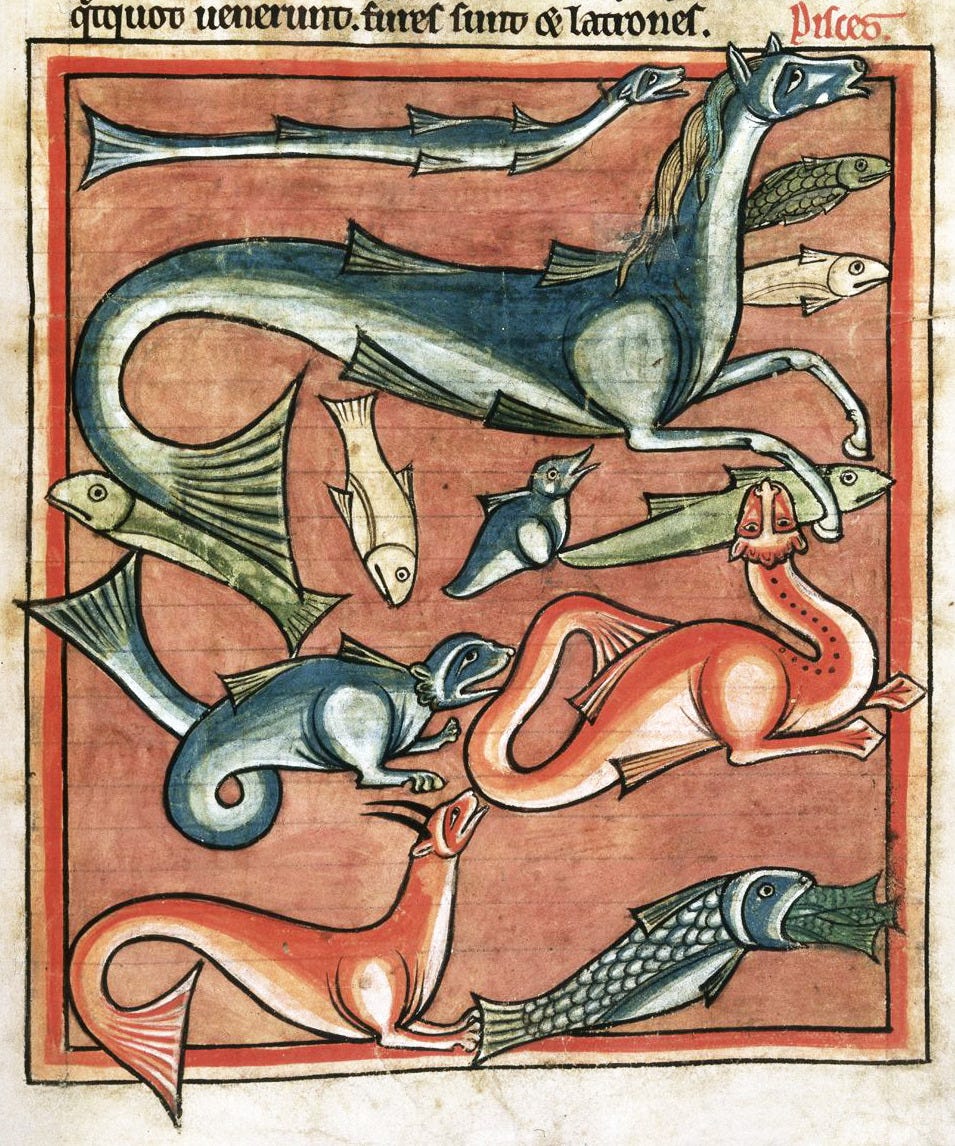
England 13th cent. / British Library, Harley 4751, fol. 68r
In 1848, the HMS Daedalus encountered a sea serpent off the southwestern coast of Africa. The creature was over sixty feet long, according to witnesses, had a wash of mane around its dark-colored neck, and passed so close to the ship that the captain remarked that, “had it been a man of my acquaintance I should have easily recognized the features with the naked eye.”
In 1915, a German submarine shelled and sank the British steamer Iberian. When the ship went down, its boilers exploded and flung wreckage into the air, including a very large, very surprised sea monster, “writhing and struggling wildly”.
In 1546, a strange creature was discovered in the Øresund between Sweden and Denmark, a fish wearing a monk’s habit. This “sea-monk” was classed as a merman, its bizarre appearance credited by naturalist Pierre Belon to the “playfulness of Nature”.
Pliny the Elder wrote that all the world has its opposite beneath the waves, dogs and roses, monks and pigs and kings. It’s deeply pedantic to point out that he was wrong. In the 21st century, we are well aware. But we look into the sea anyway, into the past, watching strange things pass us close enough to touch. Like Lucy on the deck of the Dawn Treader, there seems a chance we’ll see our own faces peering back at us, mounted on the shoulders of something deep beneath the surface.
Seas have (as well as skies) Sun, Moon, and Stars;
(As well as ayre) Swallows, and Rooks, and Stares;
(As well as earth) Vines, Roses, Nettles, Millions,
Pinks, Gilliflowers, Mushrooms, and many millions
of other Plants lants (more rare and strange than these)
As very fishes living in the Seas.
And also Rams, Calfs, Horses, Hares, and Hogs,
Wolves, Lions, Urchins, Elephants and Dogs,
Yea, Men and Mayds; and (which I more admire)
The mytred Bishop and the cowled Fryer;
Whereof, examples, (but a few years since)
Were shew'n the Norways, and Polonian Prince.
- Guillaume Du Bartas, La Sepmaine; ou, Creation du monde (1578)