VI
This iteration contains: death, doublewalkers, and the stuff of angels' bones.

I promised I’d be consistent with this thing, but life (and its implacable counterpart) has a way of disrupting plans. You don’t need the details, that’s not what you’re here for; suffice it to say that my mind has felt numb and sticky for months now and I’m only just now starting to push my way out of it, that sucking internal exhaustion that grief brings. But here we are now, in the ravenous dog days of summer, bent under a stultifying heat, and I’m all of a sudden itching to write again. So - shall we?
.
There are many things that make me want to sample a scent: unusual notes, a gap in my own collection, this queen’s newsletter - but we all know that what I’m weakest for is a carefully constructed aesthetic, which means nothing actually draws me in like a name. Hence today’s perfume. I am too much a former goth to let this pass me by.
The Decay of the Angel, by Timothy Han
Whiskey fumes as it goes on, the kind that make your ears buzz, coupled with a fragmented amber - that warm, rich scent hits my nose in pieces, rather than waves, and sinuous under both, a wet, softly rotting vegetal note. Reeds, or unflowering water lilies, something with soaked roots. But let a few minutes pass, and it reveals an indolent oud, and the faint scent of roses.
It doesn’t smell like sex. It smells like some fallen thing crashed into the matted shallows of a lake and shattered its bones into amber dust. It smells like what eroticism might be found in rotting elements the water hasn’t taken yet. It’s a weird scent, one that excites my imagination more than it loves my skin.
Pair with: platform boots and a long weed-green wool coat, a cut on your knuckle that won’t stop splitting open, eating olives in a dark bar, the insistent arousal of someone’s teeth on your neck, Harriet Frishmuth’s sculpture The Vine, and the way dead things lose their weight underwater.
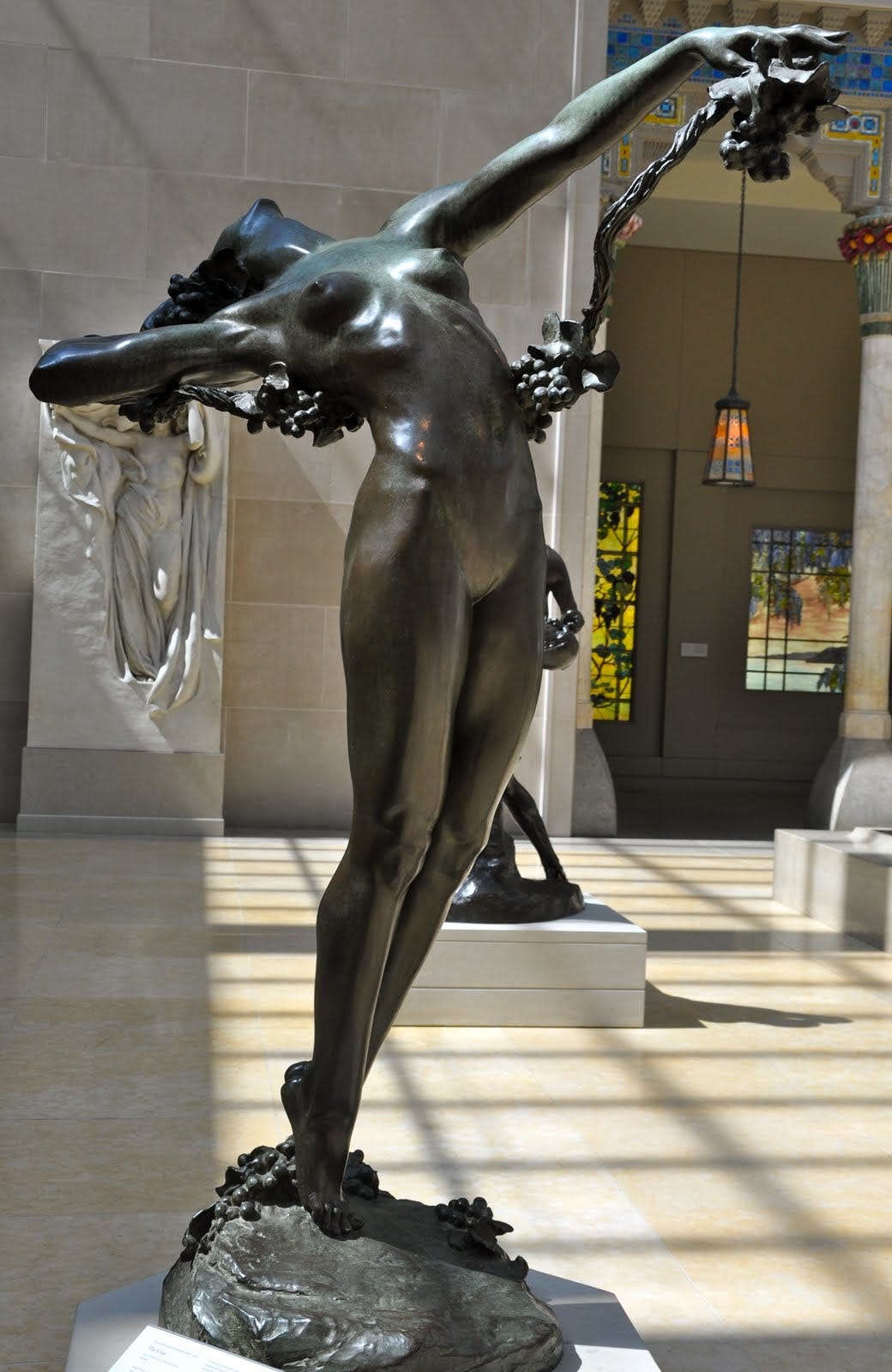
Harriet Whitney Frishmuth (American, 1880–1980). The Vine, 1921; revised 1923; this cast 1924. Bronze.
.
Speaking of death, speaking of rot, speaking of strangeness and falling in hateful love with things that barely carry a semblance of life, here is a snippet of my long-in-progress 16th century horror novella about a German executioner and his doppelgänger.
“Irreplaceable,” Albrecht sneered. His needle punched in and out of flesh. The holes frayed as sinew dragged through, so he wet his thumb, over and over again, and pressed a drop of saliva to each one, keeping them supple. “Exactly what I’d tell a prisoner if I wanted him to love his cage.”
The thing stretched across his bed turned its jawless head up at him, its tongue lolling from the root at the back of its throat. A trail of drool dampened Albrecht’s thigh. He exhaled, caught the thing firmly by the hair, and tapped the tip of his needle against its temple. “Hold still, or this will go into your brain.”
It made a sound like a flooded bellows, wet and wheezing.
Albrecht pierced its skin and resumed his sewing. Without stitches, its forehead had begun to sag, curling and peeling away from bone. Perhaps he’d waited too long to make his way back to the outskirts of the city, to climb the pole that held the wheel and the broken sinner stretched upon it, bones puncturing skin like broken spokes. By the time he’d flayed off the face, the flesh had gone stiff.
He could have waited for another execution, another body. But the raw, limp mask draped dripping over his hand had been a challenge. Albrecht’s blood beat for a challenge.
.